Background
Every journey has its own soundtrack. Most often in the form of a playlist—something some people choose with as much care as the contents of their backpack or suitcase. My most recent playlist was mostly made up of classical pieces with a jazzy or bluesy twist. Which makes perfect sense, considering the trip took me from Vienna, one of the most important centers of the classical era, all the way to Tamraght in Morocco, North Africa. And as we all know, Africa is considered the birthplace of blues and jazz! (By the way: Tamraght attracts not only surfers, but also Jimi Hendrix fans. He’s said to have spent an extended holiday there in the late ’60s.)
Of all the classical-jazz fusions I listened to, I liked the ones by pianist Jean Baptiste best—released in 2024 on the album Beethoven Blues: Batiste Piano Series, Vol. 1. And after a rather underwhelming YouTube search for equally compelling guitar versions, I decided to create my own „remix“: a blues interpretation of Beethoven’s famous piano piece Für Elise. It had two purposes—first, to honor the original in a meaningful way, and second, to be useful for my students as well (In a rush? You can head straight to the videos and the downloadable PDF with sheet music and tablature via this link).
Poor Elise
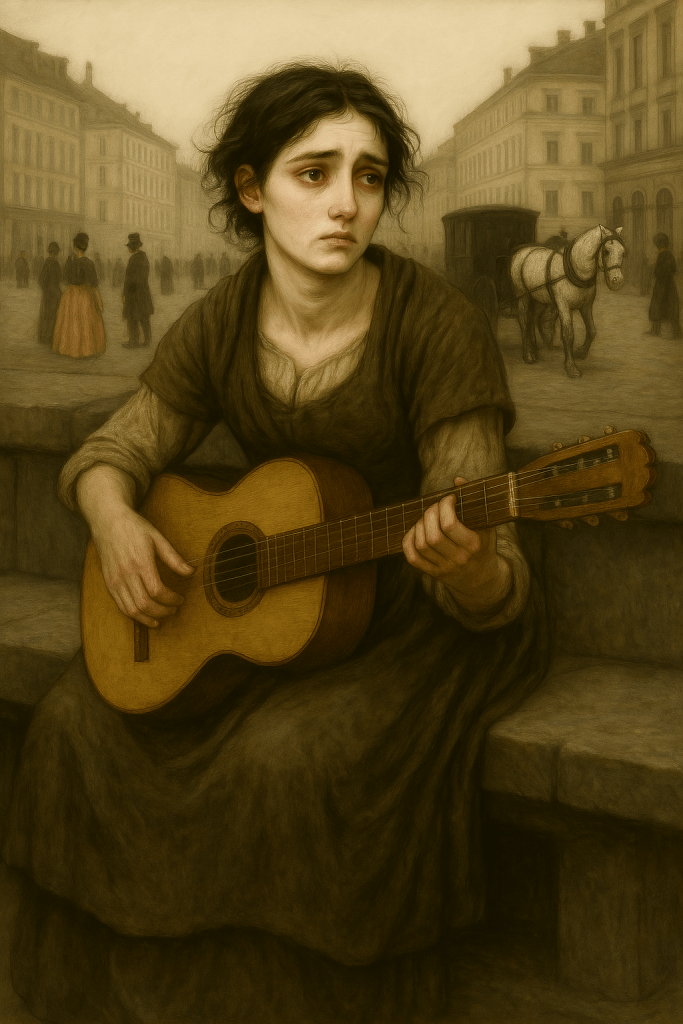
For Beginners (Level 1)
Don’t underestimate this first version despite its simplicity. While the tempo is slow and the thumb line has been separated from the finger line, the piece should be played in shuffle rhythm to really make it sound like the blues—and not just like a funeral march.
Students who struggle with this should first clap the shuffle rhythm in triplets. Once they’ve mastered that, they can try dropping the second note of each triplet. In practice, the most effective approach—honestly—has often been the simple instruction: “Long note” – “Short note.”

A good starting point is to work with the chords of the piece, since several melody notes are already contained within the chord tones of Am, E, C, and G. From a technical perspective, this approach makes a lot of sense as well: chords can serve as posts that are driven into the ground—anchors on the fretboard.

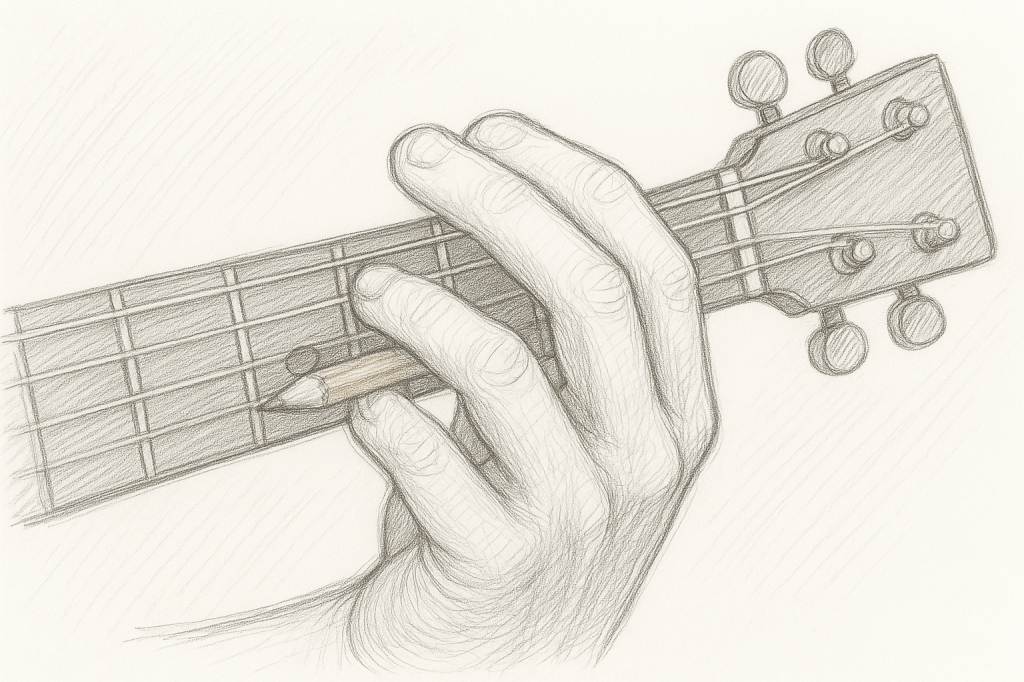
Speaking of “posts” and “supports”: Whether a student has proper hand positioning becomes especially clear when they start working on chords—particularly when they strike the bass notes of the C and G major chords. With poor posture, they often end up muting the melody notes on the higher strings.
A guitarist’s fingers should behave like vertical takeoff aircraft: they land from above onto the fretboard.
Sheet music, tablature, and audio file

For Intermediate Players (Level 2)
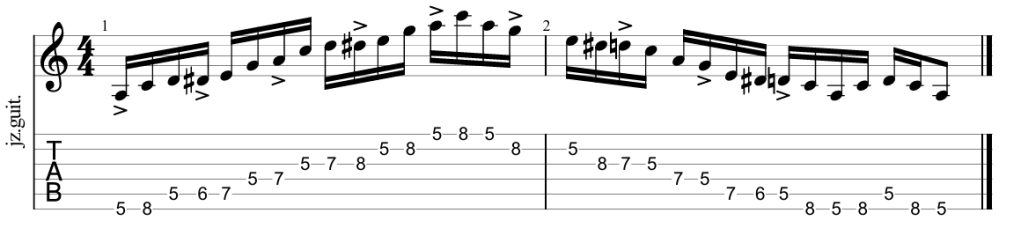
The increased tempo—10 BPM faster—is actually the least of your concerns in this version. Students should have full command of legato techniques (pull-offs, hammer-ons, trills), be able to perform string bends—ideally even with their pinky finger—and be familiar with fingerings in higher positions. A solid understanding of the blues pentatonic scale is also essential, and they should be able to play at least the first pattern fluently, ascending and descending (see diagram).
It’s incredibly helpful to take a look at classic blues intros beforehand. Typically, blues pieces begin with a chromatic sequence of thirds or sixths—or a combination of both, as the following examples demonstrate.

And this is what the blues sounds like for the advanced crowd. Enjoy!
Video: „Poor Elise“ (Advanced)
Before we get into the nitty-gritty, one very important note: Of course, the “Advanced Blues” can also be played slowly. In a more relaxed tempo, it might actually do greater justice to the theme of Poor Elise than the faster version featured in the video.
The blues then sounds like this:
For Masters (Level 3)
The difference between an advanced and a very advanced guitarist—let’s call the latter, for lack of a better term and with a touch of grandeur, a Master—can be summed up in four key aspects: (1) Perfection, (2) Dynamics, (3) Improvisation, and (4) Technique. Let’s take them one at a time.
- Perfection: It’s quite simple, really—anyone who wants to play a piece perfectly has to practice. For hours, for weeks, sometimes even months. Relentlessly, from note to note, measure to measure, until the final bar. Eventually, they’ll „nail it“—at least within the safety of their own four walls. But to play a piece flawlessly in front of an audience takes more than just the will to be perfect. It takes nerves of steel. Playing without trembling in the presence of others—or even just in front of a microphone or camera—is a challenge I myself continue to fail at… masterfully.
- Dynamics: You might call dynamics the “human factor” in music—especially considering how deeply music is intertwined with math and physics. Playing with dynamics—louder, softer, faster, slower—is, in my experience, harder to teach than technique or theory. Many students confuse ritardando (slowing down) with simply being slow, or they increase volume and tempo simultaneously when only the tempo should rise. All of this is tricky but absolutely trainable. No master ever fell from the sky.
- Improvisation: Running up and down scales is one thing—creating something original with them is something entirely different. Many guitarists command the blues pentatonic scale in every position and shape but still fall short when it comes to crafting a compelling solo. What makes a solo good? When it lingers between the ears instead of just rushing through them. When it evokes emotion—which requires emotional playing. A successful solo resembles a gripping story: if you treat it like a string of empty words and deliver it at top speed, it won’t make it any better. It’s the content that captivates.
- Technique: What musician doesn’t know it—that frustrating feeling of hitting a wall despite tireless practice, when you feel like crumpling up your score or tabs. Most of the time, the root of the problem lies in the underlying technique. Working on your technique—including posture—is just as essential as working on your repertoire. A master knows this, and dedicates a large portion of their practice time to technique. Why? Because it saves time when tackling the repertoire. Smart, right?
After this brief side trip into what distinguishes a master from an advanced player, let’s return to our joyful yet melancholic interpretation of Beethoven’s Für Elise. I tried to work precisely on those four aspects in the master-level version. (1) At around four and a half minutes, it has a substantial length—and those aiming to play it flawlessly from start to finish will be kept quite busy. (2) There’s no shortage of dynamic markings—crescendos, decrescendos, ritardandos, staccatos, fermati, and more. Whether I implemented them well—and where they actually make sense—is for the listener to decide. (3) The piece is structured A/B/A, with a brief intermezzo between B and A. In the B-section—when things get classically bluesy—players are invited to improvise. The minor pentatonic solo over the chords Am and E7 is just a signpost. What’s important here is to stay in time, following the steady quarter-note pulse set by the thumb. The art behind the art, so to speak. (4) Practice alone won’t get you far if you haven’t first built the necessary techniques—like the rasgueado strumming and fast arpeggios for the intermezzo, left-hand tapping while the right hand takes on a percussive role (in the first and second A-sections), or bass-style slapping, one-handed harmonics, and palm muting toward the end. You’ve got this!
And now, enough talk—enjoy Miha’s Master Blues!
YT-Video
Transkription
Poor Elise. A Classical Blues
10-page transcription in standard notation and tablature – covering all three levels: Beginner, Intermediate, and Master.
2,90 €
Teilen
Support the Music
Making a living as a musician is becoming increasingly difficult. Digital music generates no real income. Fair concert fees are rare. And instrumental teaching is gradually being overtaken by AI-driven apps.
Your donation helps. And it ensures that authentic, heartfelt content like this continues to exist.
One-Time Donation
Monthly Support
Annual Support
Choose Your Amount
Or enter a custom amount
Vielen Dank für deine Spende!
Vielen Dank für deine Spende!
Thank You for Your Support!

