A Brief Color Theory on a Renaissance Classic (and Its Remake)
Red
When one thinks of the English Renaissance, a parallel to American blues seems unlikely. And yet, Greensleeves—that famous lute song of the 16th century—shares more with the genre than one might expect. What unites them is the “silent echo” of unrequited love.
Longing is one of those experiences so painfully rooted in the human condition that it transcends cultures and centuries. Like blood-red threads, it weaves through time—ancient patterns dressed in ever-changing garments. Emotional yarn that binds the most diverse fabrics of art. Which brings us to the next color: green.
Green
In Greensleeves, the narrator sings of love for a woman whose green garment becomes a symbol of both hope and disappointment. “Greensleeves was all my joy / Greensleeves was my delight” – the color and the dress become a canvas for emotional projection. The garment not only adorns the object of desire, but also cloaks the pain of the one who desires. And often, this pain stretches across all things in the world – provided they are green, of course. For one driven mad by longing, green itself becomes a needle prick.
It is a metabolic—no, a diabolical pain, nourished by the hope of future conquest. Yet despite tremendous effort, that conquest stubbornly refuses to materialize.
Harmonically, this diabolism echoes in the C major chord of the refrain, and in the raised sixth degree – the F♯ of A Dorian. The Dorian mode is related to the Aeolian (minor) mode by a single semitone: in pure minor, one would play an F, but with the F♯, Greensleeves
Blue
The term blues traces back to the phrase “to have the blue devils,” meaning to be plagued by melancholy or depression. As early as the 18th century, “blue” was associated with sadness and emotional despondency. This meaning later flowed into music that expressed precisely these feelings: longing, pain, and unrequited love.
“Got my Mojo working but it won’t work for you,” laments Muddy Waters, and Eric Clapton, too, knew how to sing of dark emotions. His beloved, Pattie Boyd, was none other than the wife of ex-Beatle George Harrison. The song Layla, dedicated to her and featuring its legendary intro riff, conquered the global charts in 1971. (Not just the charts – fortunately for Clapton, also Pattie’s heart!)
One might add: a success much like Greensleeves 400 years earlier. Had there been charts back then, the song would almost certainly have topped the Renaissance hit parade. Shakespeare references the melody multiple times in The Merry Wives of Windsor – it must have been well known to the public.
The “blueness” of the blues manifests musically in the so-called blue notes – strange tonal shapes that hover somewhere between the minor and major third. According to modern harmony theory, even the diminished fifth is not considered a true blue note: it lies “slightly lower than the fifth” (Haunschield, 1994) and must be bent. Which raises the not-unjustified question of whether blues can be authentically played on a keyboard instrument at all.
On the guitar, however, it is unquestionably playable – as we’ve known since the early bluesmen of the Mississippi Delta.
Resumee
Starting from the color red, which—like the circulating blood in our bodies—symbolizes the “eternal recurrence of pain,” we passed through green, the color of deceptive hope. It lives from fleeting moments of joy and delight. And now we arrive at a new color: the blue of the blues. If the devil had a favorite color, it would surely be blue. The blue note is the place of absolute hopelessness—and as such, the devil’s favorite hiding spot. It marks the boundary between mere sadness and a severe mood disorder: depression.
But what does this mean musically? Does Ms. Greensleeves’ green dress, now interwoven with red and blue pigments, become a funeral shroud? And the piece itself a dirge? Must we add black to our little palette? By no means. If we take the hopeful C major chord from the refrain and add the minor seventh, we get a bluesy C7 chord. And seventh chords are anything but dead: they live, they resonate, they play their mischief.
Video
Sheet
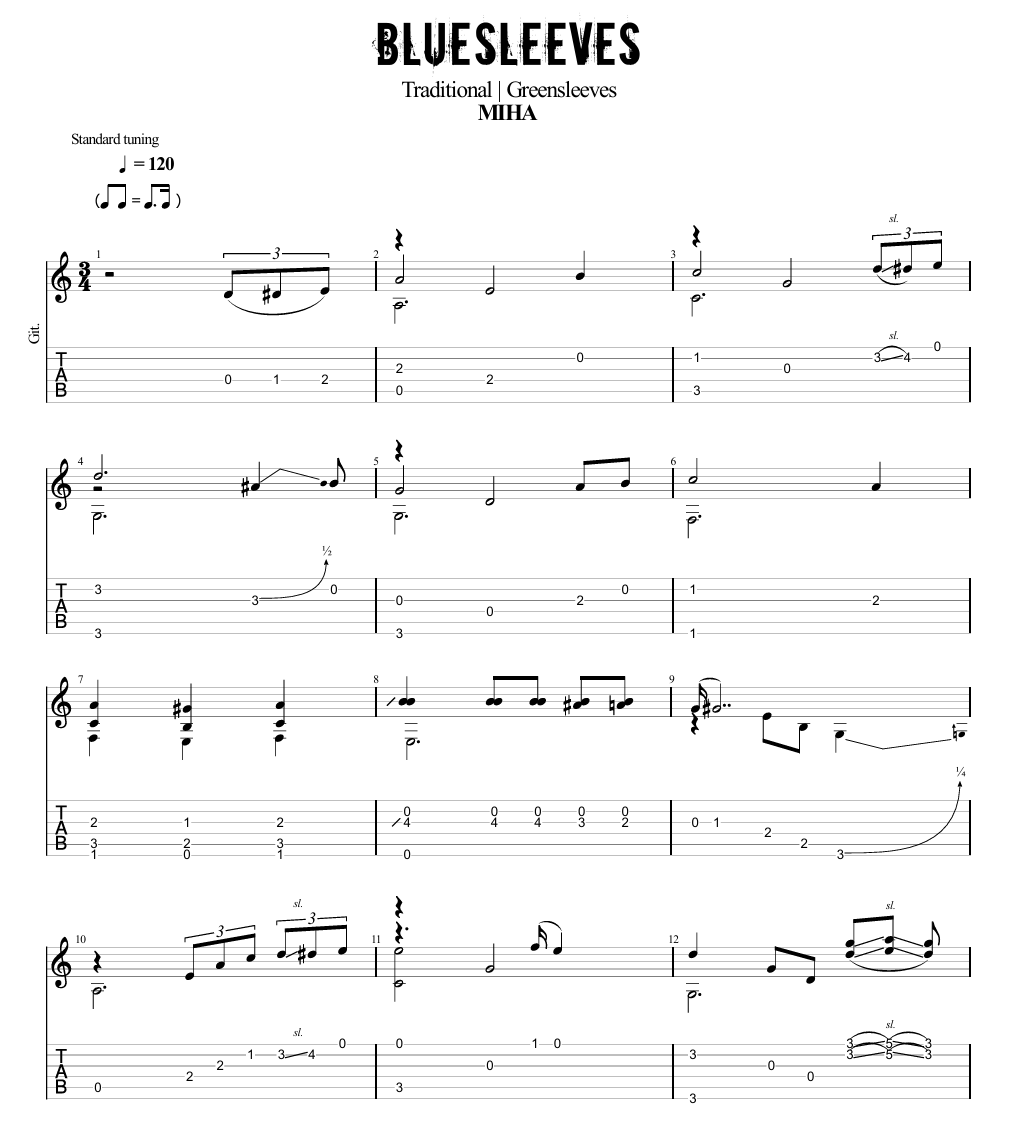
Bluesleeves
A classic reborn – Transkription in Noten und Tabulatur-Form.
1,90 €
Making a living through music is becoming increasingly difficult. Digital music generates little to no revenue. Fair concert fees are rare, and instrumental teaching is gradually being taken over by AI apps.A donation helps. And it guarantees more authentic content – created by real hands, real hearts, and real strings.
AI is already used in image generation (WordPress), in regular spelling checks, and in translations (Llama 4). But creativity needs more than algorithms – it needs soul.
Einmalig spenden
Monatlich spenden
Jährlich spenden
Wähle einen Betrag
Oder gib einen anderen Betrag ein
Vielen Dank für deine Spende!
Vielen Dank für deine Spende!
Vielen Dank für deine Spende!
SpendenMonatlich spendenJährlich spenden MIHA
MIHA 